RATIONALE
In the fifth semester the advanced application with the help of computer in the area of mail message system, local area networks and data nets and internetworking will enrich the knowledge of the students in an effective manner
1. Mail and Message System
1.1 Electronic mail and message distribution
1.2 Document and picture transmission
1.3 Voice mail, networks
1.4 Teleconferencing
2. Local Area Networks and Datanets
2.1 Types of LANs
2.2 Network components
2.3 Network layout
2.4 Network topology
Concept, Brief explanation about its peripherals, working and utilities
-
Create E-mail accounts with different user mails
-
How to operate voice mail
-
Setting up a computer system for teleconferencing
-
Making cables for attaching the computers (LAN)
-
Setting up of a server
-
Setting up of a clients
NOTE: Teachers may give more exercises to students on computers pertaining to above mentioned theory and practicals
RATIONALE
For the performance of a private secretary’s work it is necessary to have proficiency in stenography, as he has to take dictation quite often on matters of confidential nature. The objective of this subject is to enable the students to acquire a good speed in stenography
-
Figures and important contractions
-
Contractions
-
Advanced outlines of general interest
-
Advanced phraseography
-
Intersections
-
Note taking techniques and transcription on typewriter
-
Advantages of writing with pen
-
Common errors of English words
-
Dictation from seen and unseen passages and letters and reading back
-
Practising daily transcription on the typewriter
-
Practising reading printed shorthand matter (Attainment to develop ability to take notes in a neat and accurate style at a minimum speed of 80 w.p.m)
-
Dictation from newspapers, journals and books specially intended for speed building of students
-
Dictation from the tape recorder
-
Practising use of advanced phrases and contractions
-
Dictation in different voices
-
Errors to be analysed. Though the qualifying speed is 80 w.p.m but class dictation speed to go
-
gradually upto 100 w.p.m
-
Practising taking dictation from old examination papers
-
Recording class notes in shorthand
-
Recording minutes and proceedings of a meeting in shorthand
-
Assuming stenographer duties in the Principal’s Office for two days
-
Transcription 10 w.p.m on typewriter
-
Examination paper for dictation five minutes minimum at a speed of 80 w.p.m
Note:i) Students should acquire a speed of 80 w.p.m in shorthand and 40 w.p.m. in typing
ii) Full marks be given to the student in English shorthand dictation having maximum prescribed speed keeping in view other factors
For effective teaching of stenography, it is important for the teacher to familiarize students with the general background, scope of work, employment opportunities and future prospects in order to motivate them for continuous, organised and methodical learning and practising. Stenography being a new language science for students, complimentary to the language of English, the teacher is expected to simultaneously built up the language skills of learners to achieve the goal. For securing masters in the skill the following steps are prescribed:
-
Assessment of student group profile i.e. determining the aptitude level of each student.The intakenot to exceed 15-20 students
-
Presentation of subject with due emphasis on practicals
-
Proportional teaching of topics during the prescribed semester period
-
Use of only shorthand notebook and pencil
-
Ensure right direction for writing strokes and signs and their proper length
-
Emphasis on legibility of outlines and repeated practice
-
Monitoring of vowel placement and positioning at the initial stage
-
Repeated practice of prescribed word exercises, grammalogues, phrases etc
-
Strict adherence to speed exercises at different speed levels from simple to complex
-
Practice variety of speed drills
-
Periodical tests during the course for remedial teaching
RATIONALE
The basis thrust of the course is to generate efficiency, effectiveness and excellence in the world and performance of the office viz-a-viz to achieve optimum productivity in the office operations. An emphasis is laid in this course to inculcate practice amongst the students to use "Time and Labour Saving Devices" as well as different systems and procedures and to keep them abreast with the latest and modern techniques and practices in offices within and outside the country.
1.1 Telephone memory, directory and conference equipment
1.2 Telephone answering machine
1.3 Detecting devices
1.4 Intercom
1.5 Telephone
1.6 Fax
1.7 PBX, EPABX
1.8 Public Address Systems
1.9 Dictation network
1.10 Paging system
1.11 E-mail
1.12 Internet
1.13 Mobile phone
1.14 Electronic stencil cutting machine
1.15 Electronic typewriter
3. Modern Accountancy Equipments
3.1 Electronic calculator
3.2 Electronic cash register
3.3 Electronic billing machine
3.4 Electronic weighing machine
3.5 Notes sorting and counting machines
4. Modern office security/safety systems and equipments
4.1 Time/attendance recorder
4.2 CCTV
4.3 Metal detector
4.4 Fire extinguisher
4.5 Fire/security alarms
4.6 Walkies-talkies
4.7 Incoming/outgoing inventory register at security check-post
-
Preparing stencils on scanner
-
Handling telephone, receiving and answering calls, transferring calls, counsulting telephone directory, taking messages, placing calls local, STD and ISD, booking trunk calls, using special telephone services such as phonograms, time enquiry, special information, assistance for dialing etc., use of aids such as answering machine, and message recording. Preparing a telephone index,handling telephone bills, maintaining records of calls made
-
Operation of EPABX
-
Familiarization with the operation of TELEX and FAX
-
The students may be asked to operate any of the communication system available at the institute/around the institute (in industry)
-
The students may be asked to perform functions on electronic cash register/billing machines
-
The students may be asked to perform functions on time record/mail machines
-
Group discussions may also be organized
-
There will be practicals and no theory examination
-
The students may be made aware about other modern office systems by arranging their visits to the organisation where such equipments exist.
The study of the subject is very important for the student of this diploma in understanding the various types of business organizations. The course includes nature, scope and form of business organizations. Since the students have to work in the capacity of personal secretary/personal assistant the knowledge of income tax and service rules is included in the contents of this course.
1. Nature and scope of business organizations
1.1 Meaning and scope of business
1.2 Business and profession
1.3 Requisites of a successful business
1.4 Qualities of a good businessman
1.5 Business ethics
3. Forms of Business organisation
3.1 Individual proprietorship
3.2 Partnership
3.3 Private limited companies
3.4 Public limited companies
4. Finance
4.1 Calculate total capital requirement and sources
4.2 Sources of capital - own and borrowed, private partnership and private company, shares, debentures
5. Income Tax Act
Income tax planning, calculation of taxable income of a salaried individual, knowledge and practice of filing income tax return
6. Administrative Service and Personnel Matters
6.1 Rules governing TA/DA, leave; pensionary benefits; staff conveyance, medical attendance; conduct classification, control and appeal rules; attendance and punctuality
6.2 Service matters pertaining to confirmation, seniority, promotion, confidential reports and resignation
RATIONALE
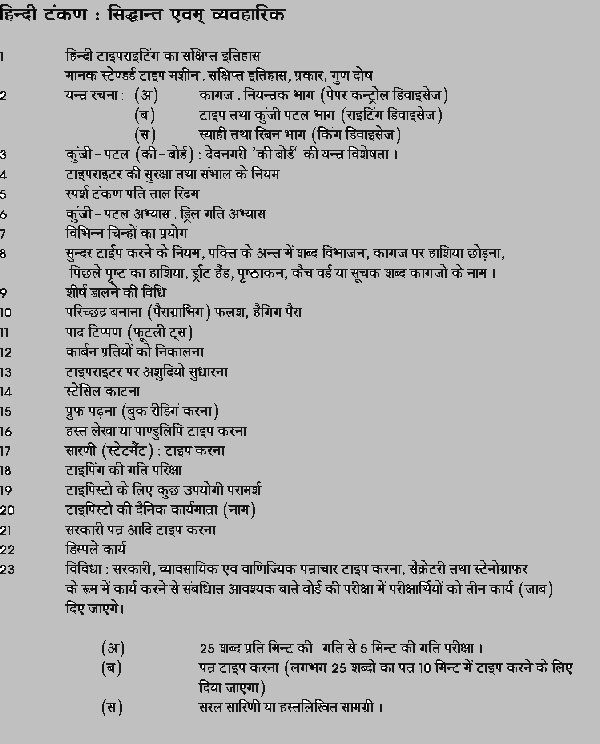
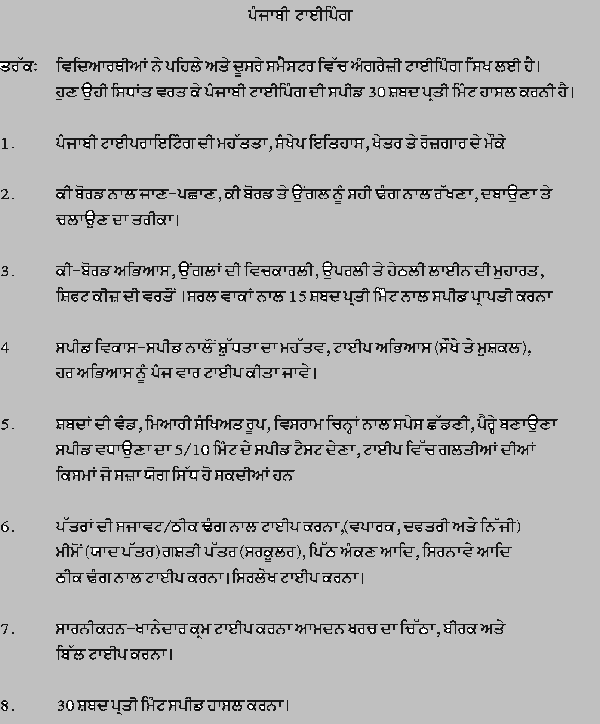
The students have already learnt how to type on English typewriter. Now they will apply the same theory on Hindi typewriter and learn to operate keyboard on Hindi typewriters.
RATIONALE
The students shall do practice on electronic typewriting (bilingual) during this course which will increase their proficiency in typing skills.
-
Introduction to Electronic typewriting
-
Types and makes of Electronic typewriting
-
Advantages of electronic typewriting over conventional system
-
Special features of electronic typewriter
-
Practice on electronic typewriter
-
Preparing machine for operation, changing daisy wheel, correction tape and ribbon etc
-
Feeding the paper manually and with commands
-
Setting the margins, margins by passing
-
Operation functions keys-shift, return, express return, repeat, relation, half-spacing, erasing line pacing
-
Character spacing, using tabulator keys
-
Special functions - centering, alignment, corrections, justifications etc
-
Memory - Entering text, printing, correcting the text, deleting a file and related functions
-
Practising all types of correspondence, financial statements etc.
-
Practising shorthand transcription on electronic typewriter
RATIONALE
There is a wide spread unemployment in the country. This unemployment is not confined to any specific discipline. More over enterprising persons are found in all streams of education. In this diploma course also there would be some persons who may like to go for self employment. The main objective of this course is to motivate enterprising students to opt for self-employment and entrepreneurial venture.
1. Introduction
-
Need, scope and nature of entrepreneurship, entrepreneurial competencies
2. Enterprise support systems
-
Facilities and schemes of assistance of following organisations:
-
National Level organisations: DCSSI, SIDO, NSIC, NRDC, SIDBI, EDII, Commercial Banks etc
-
State level organisations: SFC, SSIEC, TCOs, SISIs, State level Banks etc
-
District level: DIC, KVIC, Distt Level Banks etc.
3. Opportunity Identification
-
Considerations in project/product selection. Emerging opportunities
4. Enterprise Establishment and Start up
-
Market survey, preparation of preliminary project report project feasibility, detail project report, project appraisal, submitting loan application
5. Enterprise Management
-
Brief introduction (Definitions and concepts only) to financial management, marketing management, production management and work force management
6. Achievement Motivation Training
-
Brief introduction and concept with a few selected simulation excercises e.g. ring toss game and tower building exercises
7. Business Environment
-
Significance of business environment and its changing dimensions. Indian Industrial scenario and relevance of small scale industries, industrial policy resolutions, chambers of commerce and industry and trade associations
-
Market survey on identified and selected project
-
Collection of schemes of assistance of various agencies
-
Collection of cases of small successful entrepreneurs for understanding the practice of entrepreneurship
-
Preparing detailed project report on identified and selected project
-
Study of business environment affecting the start up of an entrepreneurial venture
Note:
Teachers teaching this course are advised to
prepare and send a proposal to Department of Science and Technology,
New Delhi through their State Council of Science and Technology for
organising 3 days Entrepreneurship Awareness Camp (EACs) in their
institutions. Such camps will be helpful in covering the contents of
this course.